Send Money To and From Vietnam as a Foreigner: Banks and Apps Compared
A foreigner can send money out of Vietnam through a licensed bank. Vietcombank charges 0.2%, minimum US$5, plus a US$5 SWIFT fee. Its maximum depends on the purpose. BIDV charges 0.2%, minimum US$5, maximum US$5,000, plus a US$5 telex fee.
On this page
- Which route to use: quick pick
- What the law allows
- Vietcombank: transfers out
- BIDV: transfers out
- Wise: app transfers into a Vietnamese bank account
- Western Union: bank accounts, wallets and agents
- WorldRemit and Xoom
- Receiving in a Vietnamese bank account
- Before you send: check the provider and the rate
- Carrying cash out instead
- Common questions
Money out of Vietnam and money into Vietnam are different problems. Out goes through a licensed bank counter, with the papers that bank sets. In has several app routes, each with its own fee line.
Foreign-exchange services are only offered by institutions the State Bank has approved in writing.
Which route to use: quick pick
| You want to | Route | Key fact |
|---|---|---|
| Send salary out to your own foreign account | Bank counter, SWIFT | Vietcombank own fee 0.2%, minimum US$5, plus US$5 SWIFT fee |
| Send out from a BIDV account | Bank counter, SWIFT | BIDV own fee 0.2%, minimum US$5, plus US$5 telex fee |
| Pay a Vietnamese bank account from abroad | Wise | Fee from 0.24% |
| Pay a Vietnamese bank account or wallet from abroad | Western Union | First online transfer fee $0 |
| Pay a Vietnamese bank account or wallet from abroad | Xoom | Funds typically deposited in minutes |
What the law allows
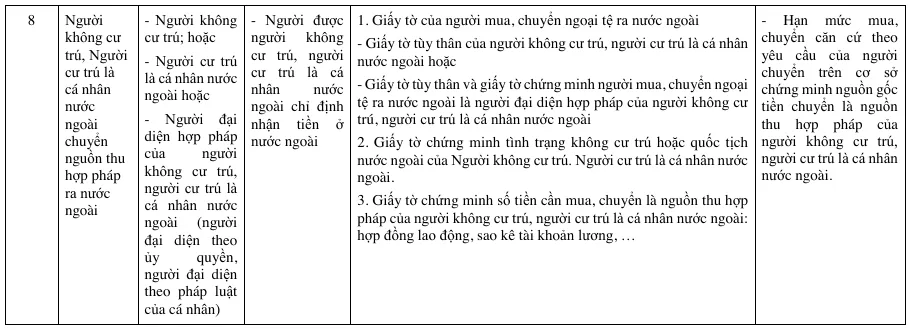
Vietnamese law lets a foreigner send money out through a bank. A non-resident, or a resident who is a foreigner, with foreign currency in an account may transfer it abroad. With lawful Vietnamese-dong income the person may buy foreign currency to transfer abroad.
Người không cư trú, người cư trú là người nước ngoài có ngoại tệ trên tài khoản được chuyển ra nước ngoài; trường hợp có nguồn thu hợp pháp bằng đồng Việt Nam thì được mua ngoại tệ để chuyển ra nước ngoài.
A non-resident, or a resident who is a foreigner, who has foreign currency in an account may transfer it abroad; with lawful Vietnamese-dong income the person may buy foreign currency to transfer abroad.
Foreign Exchange Ordinance, consolidated text of 23 September 2026, Điều 8 khoản 4
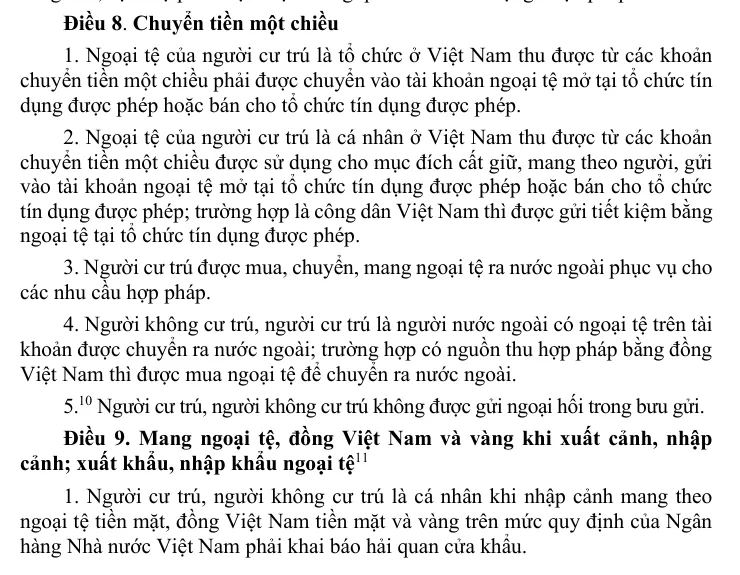
The decree adds lawful foreign-currency income next to account balances. A one-way transfer is a gift, aid or family-support transfer for personal spending, not tied to payment for goods or services. Payments and transfers for current transactions include one-way transfers.
Who is a resident?
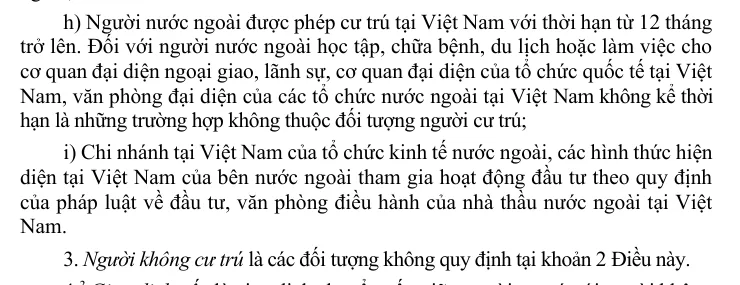
A foreigner permitted to reside in Vietnam for 12 months or longer is a resident. A foreigner in Vietnam to study, receive medical treatment or travel is not a resident, whatever the length of stay. A non-resident is anyone not listed as a resident.
Tax residency is a separate test: see the tax residency guide.
What it means for your papers
A licensed credit institution must examine the papers you present to transfer or confirm the source of foreign currency. You must present the documents the institution requires, and you are responsible for their accuracy.
Documents confirming completed tax obligations are not required for these transfers. The same text lets banks examine each transfer on its actual and reasonable need.
Khi mua, chuyển, mang ngoại tệ ra nước ngoài phục vụ các giao dịch vãng lai, người cư trú, người không cư trú không phải xuất trình các chứng từ liên quan đến việc xác nhận hoàn thành nghĩa vụ thuế với Nhà nước Việt Nam.
For current transactions, residents and non-residents do not have to present documents confirming they have completed their tax obligations to the Vietnamese State.
Decree 70/2014/NĐ-CP, Điều 4 khoản 3
Vietcombank: transfers out
The bank account guide covers the accounts open to a foreigner. A resident foreigner may credit a foreign-currency account with salary, bonus or allowance payments and debit it to transfer money abroad.
Vietcombank’s English page lists foreign residents legally residing and working in Vietnam among customers who can transfer money abroad. Its counter guide says it applies to Vietnamese and foreign individuals transacting at the bank.
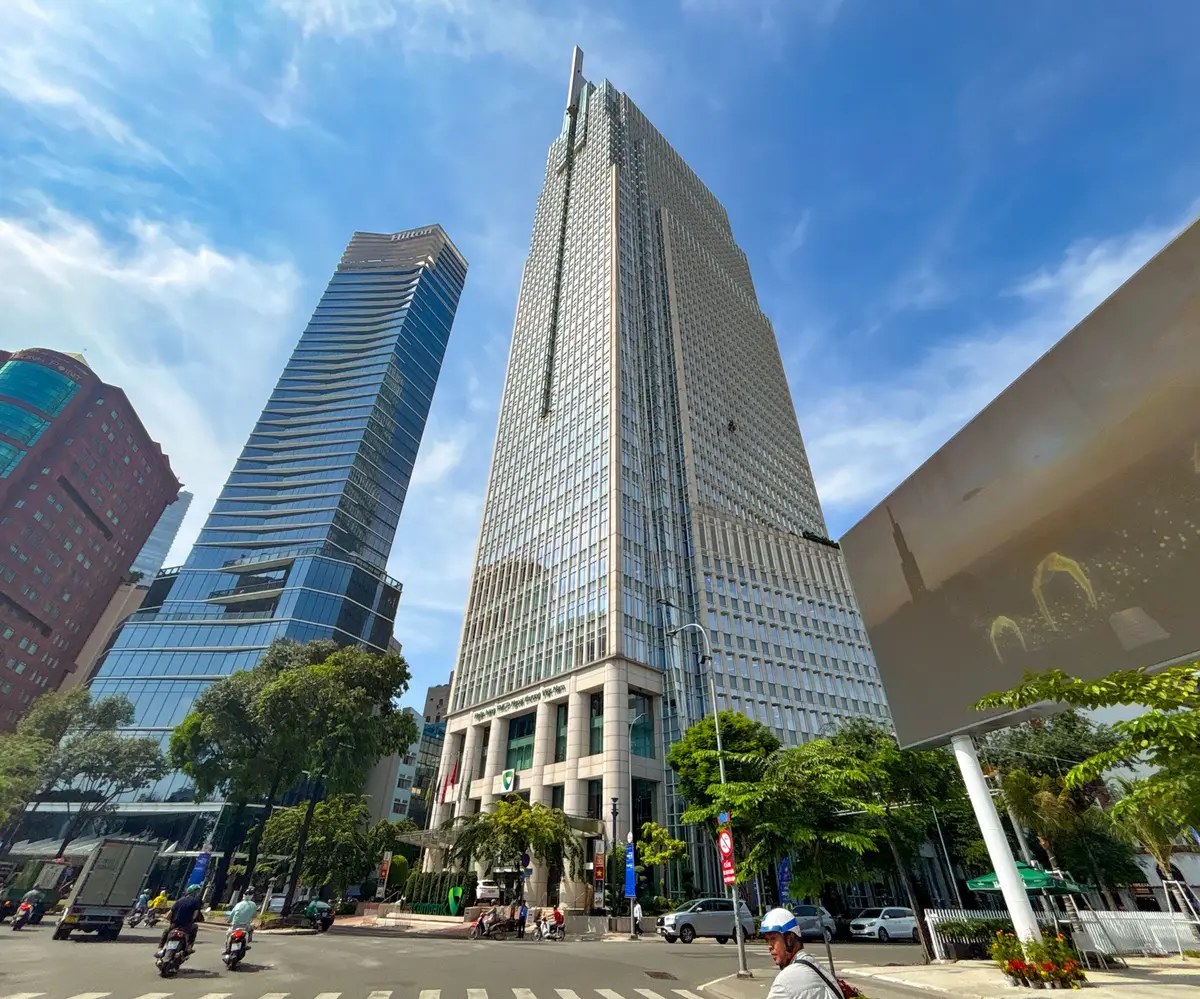
5 Cong truong Me Linh, Sai Gon, Ho Chi Minh, Vietnam · Open in Google Maps (opens in a new tab)
The Ho Chi Minh City Branch is at 5 Cong truong Me Linh, with telephone +84 28 3829 7245.
Fee, papers and speed
- Own fee: 0.2% with a US$5 minimum. The maximum depends on the purpose: US$200 for study, medical treatment, family support, travel or business travel abroad, and US$990 for other purposes. The schedule is for individual customers and takes effect from 6 July 2026.
- SWIFT message fee: US$5 per message.
- Intermediary bank: if you ask Vietcombank to pay the foreign intermediary so that it takes nothing from the amount, the fee is US$10 per USD transfer. If the beneficiary must receive the whole amount of a USD transfer, it is US$30.
- VAT and other banks: the levels exclude VAT, and fees owed to other banks in the chain are collected when they arise.
- Papers: your identity paper and a paper proving non-resident status or foreign nationality. A paper proving the money is lawful income, such as an employment contract or salary account statements, is also asked for.
- Amount: the guide sets the amount by your request, on proof that the money is lawful income.
- MoneyGram: the bank’s English page lists a MoneyGram transfer out. Neither bank publishes a paper list for a foreigner, so this page leaves it out of the quick picks.
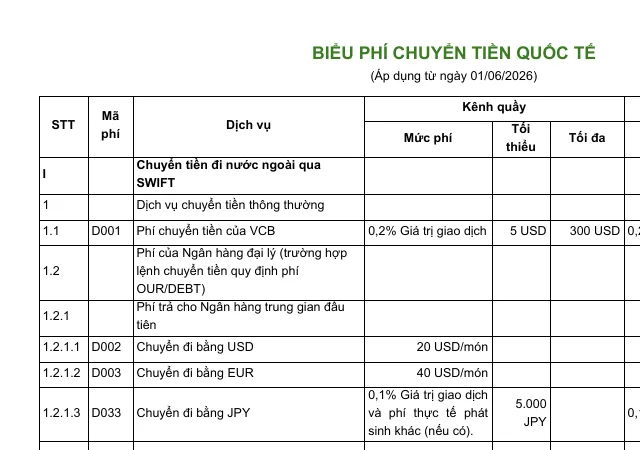
The bank’s English exchange-rate page lists cash buying, telegraphic buying and selling rates, and its English site gives the hotline 1900 54 54 13. The counter guide is an older PDF: treat it as the bank’s practice, not as law.
BIDV: transfers out
BIDV’s page on transfers from Vietnam abroad lists a valid identity paper for the sender, a temporary or permanent residence card for a foreign individual, and papers proving the purpose. It supports cash and account transfers in many currencies.
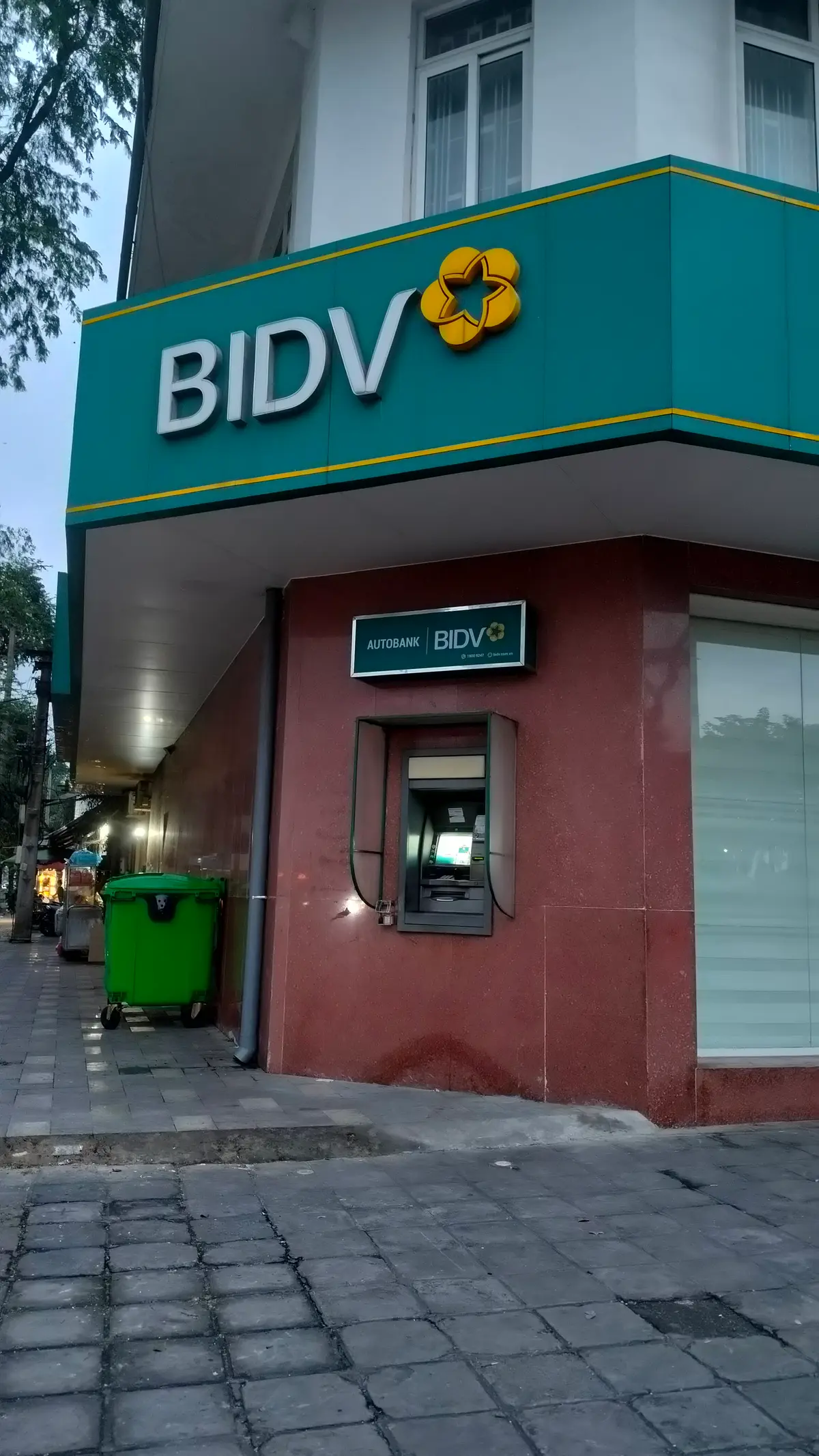
4-6 Vo Van Kiet, P. Nguyen Thai Binh, Quan 1, TP Ho Chi Minh, Nguyen Thai Binh, 1, Sai Gon, Ho Chi Minh 700000, Vietnam · Open in Google Maps (opens in a new tab)
BIDV Transaction Office 2 is at 4-6 Vo Van Kiet, Nguyen Thai Binh Ward, District 1, with telephone +84 28 3821 7378. That listing still prints the old ward and district names. The address guide shows the current ward names.
Fee and speed
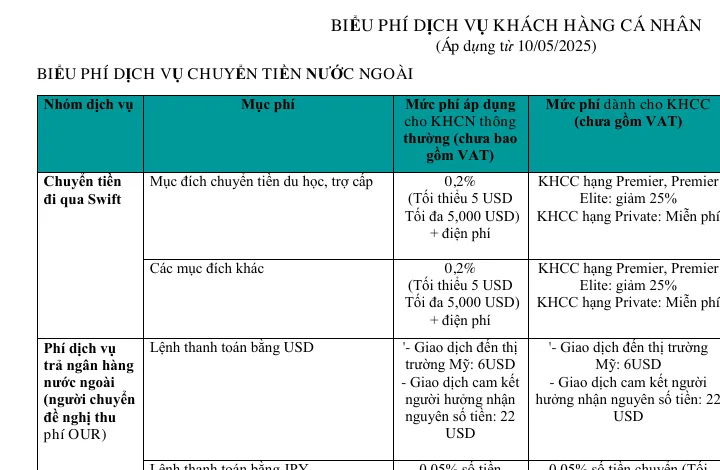
- SWIFT, other purposes: 0.2%, minimum US$5, maximum US$5,000, plus a telex fee of US$5, on the schedule applying from 10 May 2025.
- OUR charge: if you pay the foreign bank’s charge, BIDV charges US$6 for a USD order to the US market. A full-amount guarantee is US$22.
- VAT: the column for standard individual customers is headed as not including VAT.
- Western Union: BIDV sends a Western Union transfer out at Western Union’s own fees. Neither bank publishes a fee list for a foreigner, so it is not in the quick picks.
On 13 October 2026 BIDV’s fee page still listed the 10 May 2025 schedule as its foreign-transfer schedule. The BIDV page does not say what counts as a paper proving purpose for a foreigner.
What a transfer out costs in total
Add the bank’s own percentage, the message fee, any intermediary line you choose to pay, and VAT. Fees owed to other banks in the chain are collected when they arise.
| Item | Vietcombank (individual) | BIDV |
|---|---|---|
| Own percentage | 0.2% | 0.2% |
| Minimum | US$5 | US$5 |
| Maximum | US$200 or US$990, by purpose | US$5,000 |
| Message fee | US$5 | US$5 telex fee |
| Pay the foreign bank’s charge | US$10, or US$30 for the full amount | US$6 to the US market, US$22 for the full amount |
| VAT | Not included | Column header says not included |
Wise: app transfers into a Vietnamese bank account
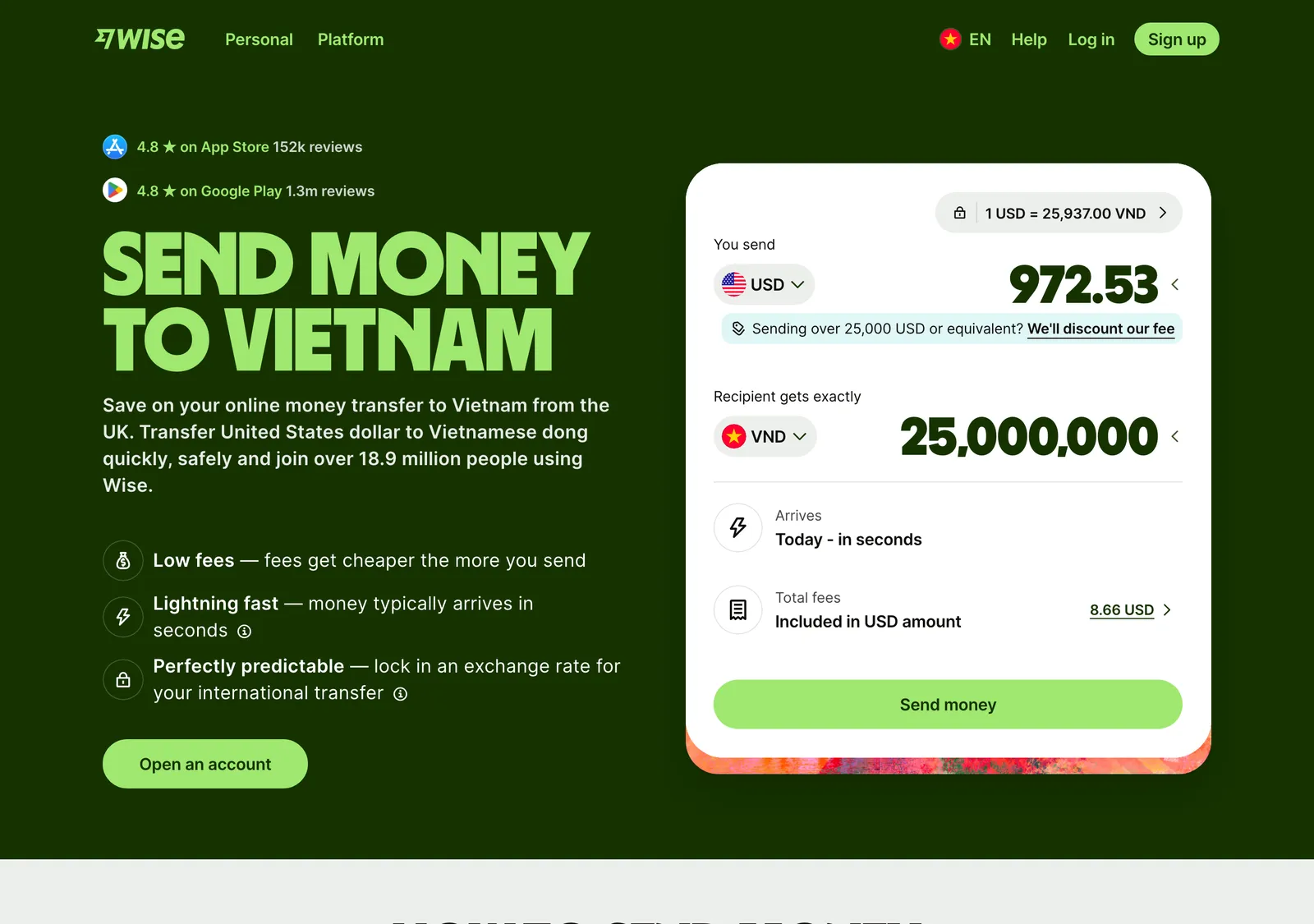
Wise covers money coming in. It says the sender pays in US dollars and the recipient gets Vietnamese dong from Wise’s local bank account. The recipient needs no Wise account.
Wise sends VND to individual and business bank accounts in Vietnam. It needs the recipient’s full name, bank name and account number.
- Fee: varies by currency and starts from 0.24%. Wise uses only the mid-market rate.
- Cheapest way: paying from money already in a Wise account.
- Large transfers: a fee discount above 25,000 USD.
- Limits: a cap of 499,999,999 VND, and minimums of 10,000 VND for personal and 50,000 VND for business recipients.
- Speed: 77% of transfers arrive in under 20 seconds and 95% in less than a day, depending on how you pay. A VND transfer usually takes 1 working day to reach the recipient’s bank.
If a bank transfer to Wise is not linked to your payment, you upload a proof of payment document.
Western Union: bank accounts, wallets and agents
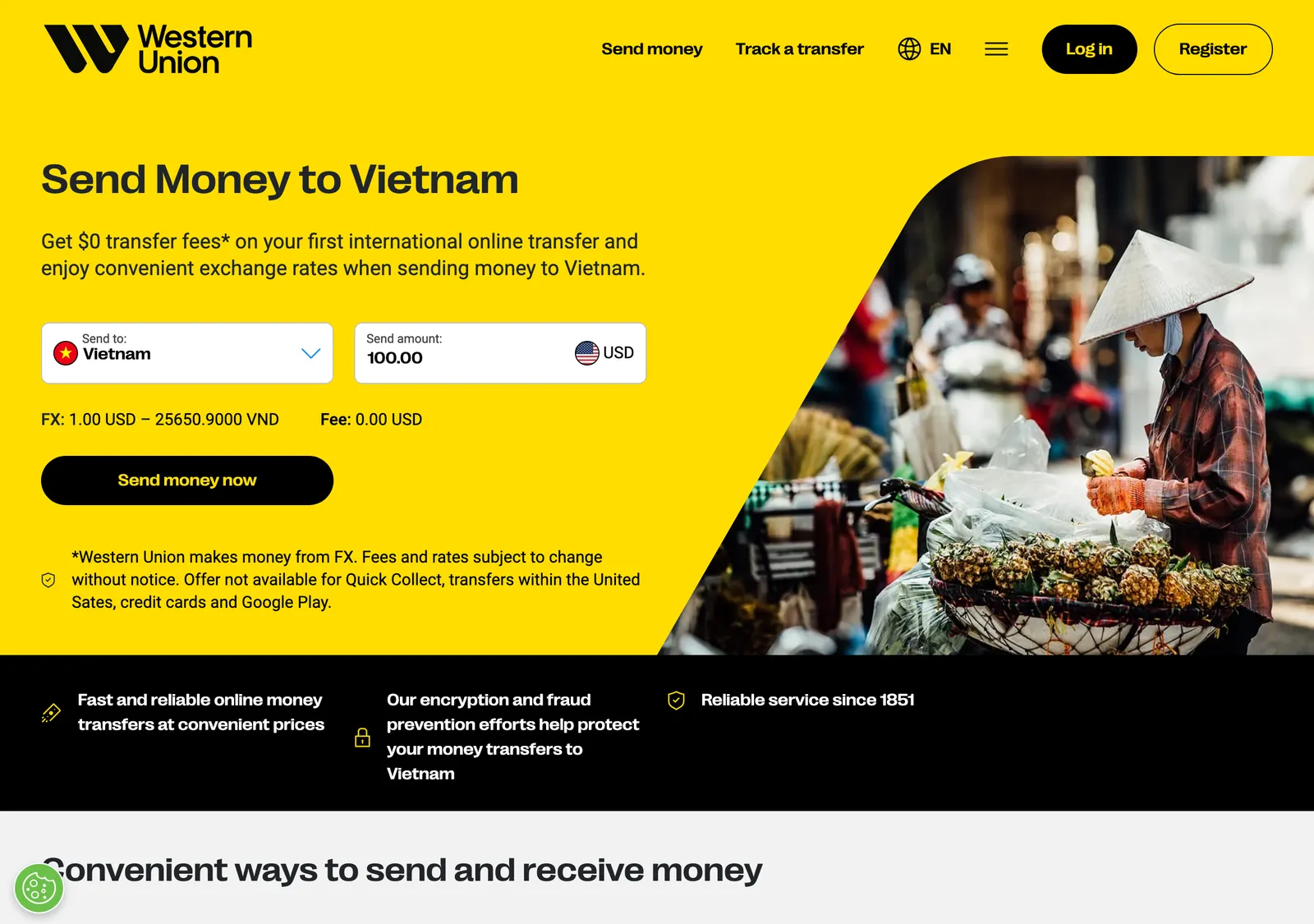
Western Union transfers directly to accounts at all major banks in Vietnam. It can send to Vimo mobile wallets in Vietnam, with delivery in minutes.
- Fee: $0 on a first international online transfer; it also makes money from exchange rates.
- Bank transfers: it needs the recipient’s full name, address with postal code, bank name and account number.
- In person: a transfer to a bank account can take up to 3 bank business days in the destination country. At an agent you pay cash including the fee.
WorldRemit and Xoom
WorldRemit’s fee depends on the receive method and does not vary with the amount. 90% of transfers to Vietnam reach its local partners within minutes. It requires a bank account, debit card or credit card to pay.
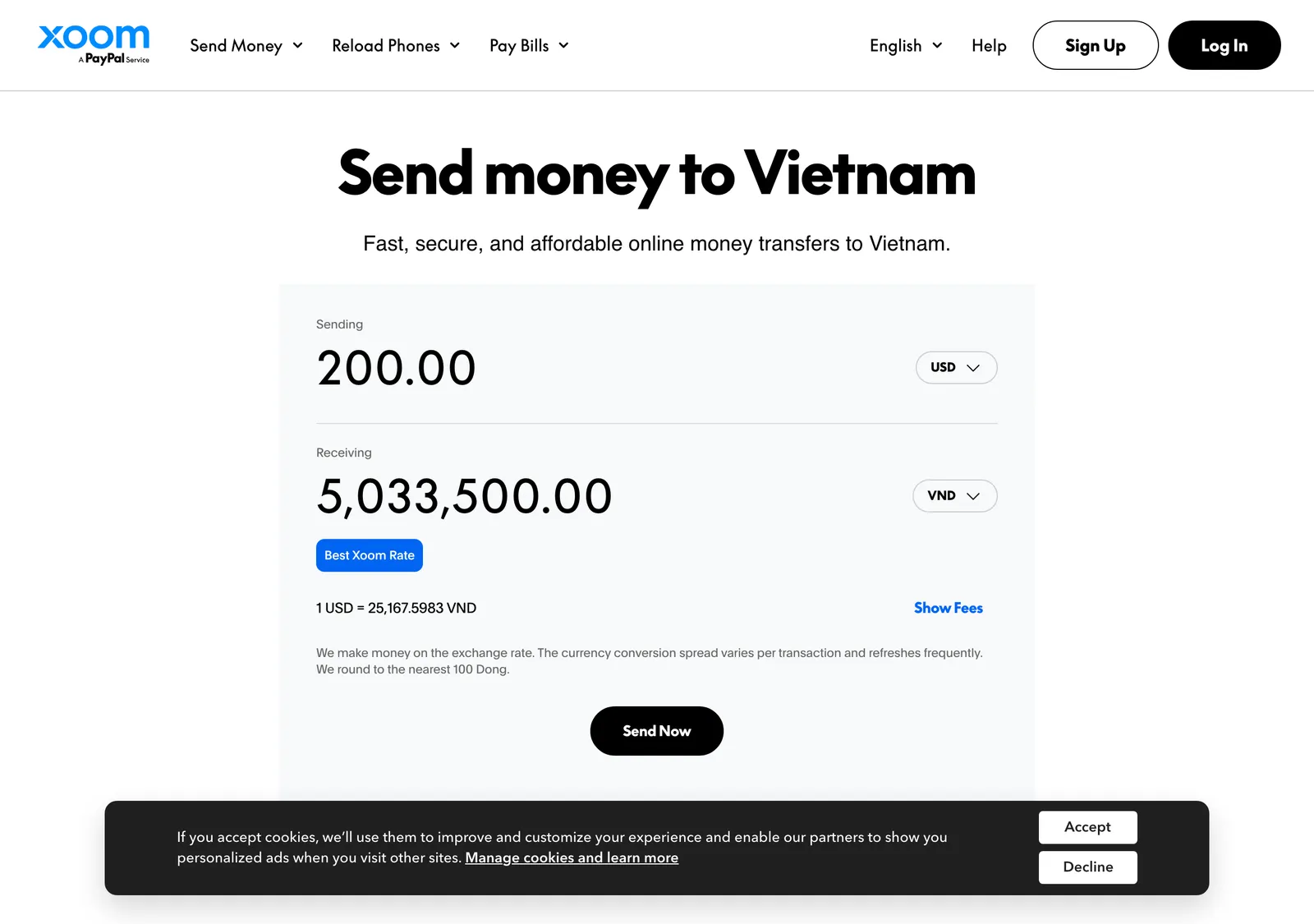
Xoom funds are typically deposited in minutes. Door-to-door delivery arrives the same day in city areas and within 2 days in most rural areas. It can send to the mobile wallets MoMo and VNPT Pay. It also makes money when it changes the send currency.
Receiving in a Vietnamese bank account
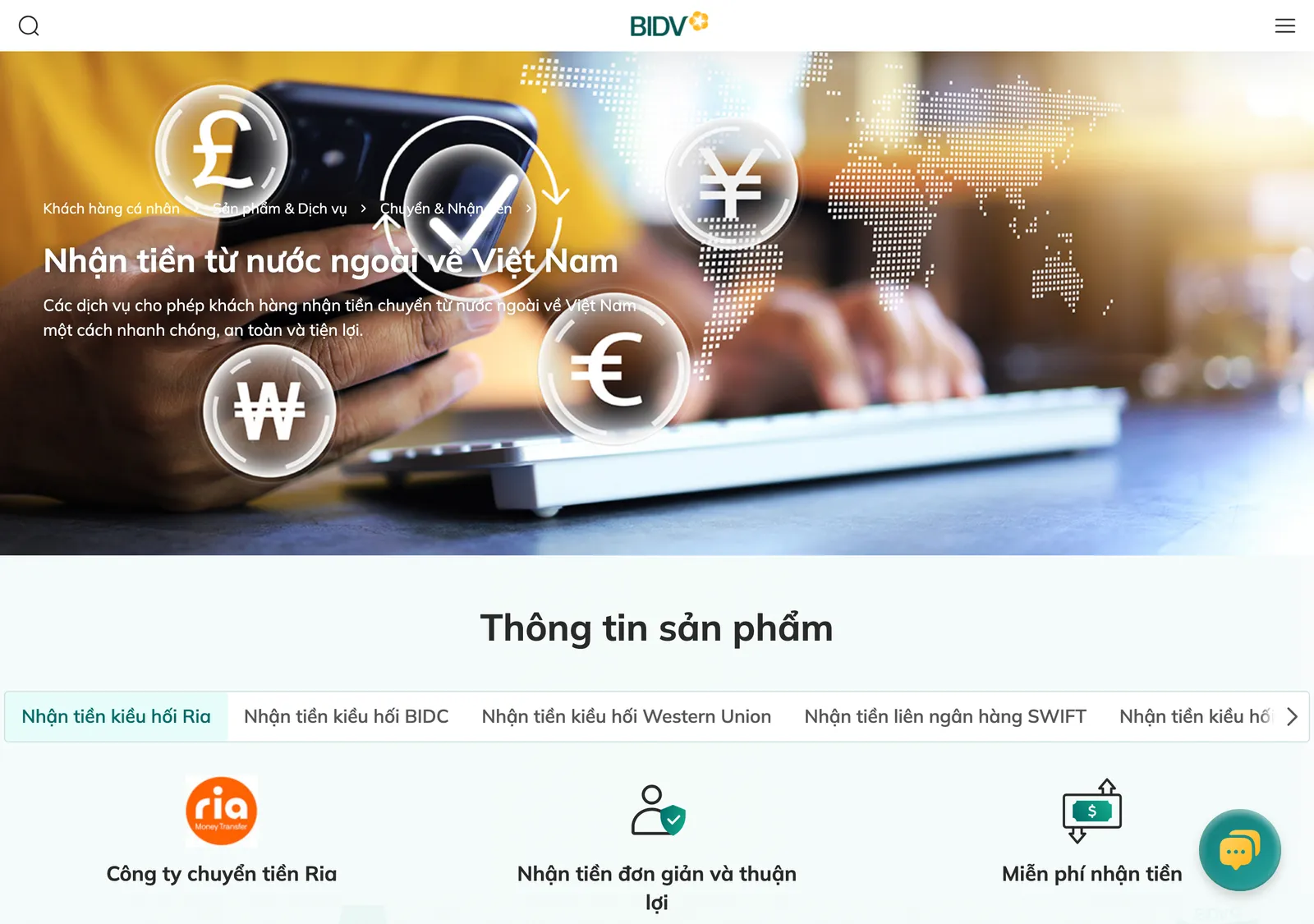
Vietcombank’s English page says SWIFT receipts are accepted in VND, USD or other currencies, and that receiving into an account or cashing out at its counters is free. BIDV’s page says Western Union money can be received free at its branches in VND or USD.
BIDV accepts SWIFT transfers in many currencies, with no limit on the amount received, and they are free when received in VND. Neither bank publishes anything specific to foreigners as receivers.
A non-resident individual may credit a foreign-currency account with money transferred in from abroad. A resident foreigner may credit one with salary, bonus or allowance payments.
Before you send: check the provider and the rate
Providers earn on exchange rates as well as fees. Western Union makes money from foreign exchange, and so does Xoom when it changes the send currency.
Wise uses only the mid-market rate, the one you can check on Google. Compare what the recipient receives with the fee line before you pay.

Carrying cash out instead
An individual leaving with foreign-currency cash, dong cash or gold above the State Bank level must declare it to customs at the border gate. By passport, the amounts are above US$5,000 or VND 15,000,000. Foreign exchange may not go in postal items.
The paperwork for tax is a separate matter. See Vietnam income tax for remote workers for how foreign pay is taxed, and currency exchange in Ho Chi Minh City for changing cash. Cash from a machine is covered in the ATM fees guide.
Both fee schedules say they can change, so read the date on the schedule you rely on.
Photos and clips uploaded to Google Maps (Vietcombank Tower on Google Maps (opens in a new tab), BIDV on Google Maps (opens in a new tab)) by Hoang Van, Lars Lekken, Pham Thanh Nam.
Not confirmed: Whether BIDV and Vietcombank accept a foreign employee's papers for money out through MoneyGram or Western Union: neither bank publishes a paper list. Which Vietcombank maximum applies to a salary transfer: the schedule sets it by purpose and does not name salary.
Common questions
Can a foreigner send money out of Vietnam?
A non-resident, or a resident who is a foreigner, who has foreign currency in an account may transfer it abroad. With lawful Vietnamese-dong income the person may buy foreign currency to send.
What does a bank charge to send money abroad?
Vietcombank's own fee is 0.2%, minimum US$5, with a maximum set by purpose: US$200 for study, treatment, family support or travel, US$990 for other purposes. It adds a US$5 SWIFT message fee. BIDV charges 0.2%, minimum US$5, maximum US$5,000, plus a US$5 telex fee. VAT is extra at both.
What else can raise the cost of a transfer out?
If you ask the bank to pay the foreign intermediary, the full amount arrives. At Vietcombank that costs US$10 per USD transfer, or US$30 if the beneficiary must receive the whole amount. BIDV charges US$6 to the US market and US$22 for a full-amount guarantee.
What does a bank ask for?
An identity paper and a paper proving non-resident status or foreign nationality, plus a paper proving the money is lawful income.
Do I need to show tax papers to send money out?
For current transactions, residents and non-residents do not have to present documents confirming they have completed their tax obligations. The bank still examines the papers you show for each transfer.
How much cash can I carry out without declaring it?
By passport, cash above US$5,000 or VND 15,000,000 must be declared to customs.
Can I send foreign exchange by post?
Residents and non-residents may not send foreign exchange in postal items.
How fast does Wise deliver to a Vietnamese bank?
A VND transfer with Wise usually takes 1 working day to reach the recipient's bank after conversion.
Which Vietnamese bank offices are pinned for Ho Chi Minh City?
Vietcombank's Ho Chi Minh City Branch at 5 Cong truong Me Linh, and BIDV Transaction Office 2 at 4-6 Vo Van Kiet.
Read next
Places in this guide
General information checked against the sources listed above, not legal advice for your situation. Rules and office practice change; confirm with the immigration office or a licensed adviser before you act. See how guides are checked.
Spotted an error? Report it.